
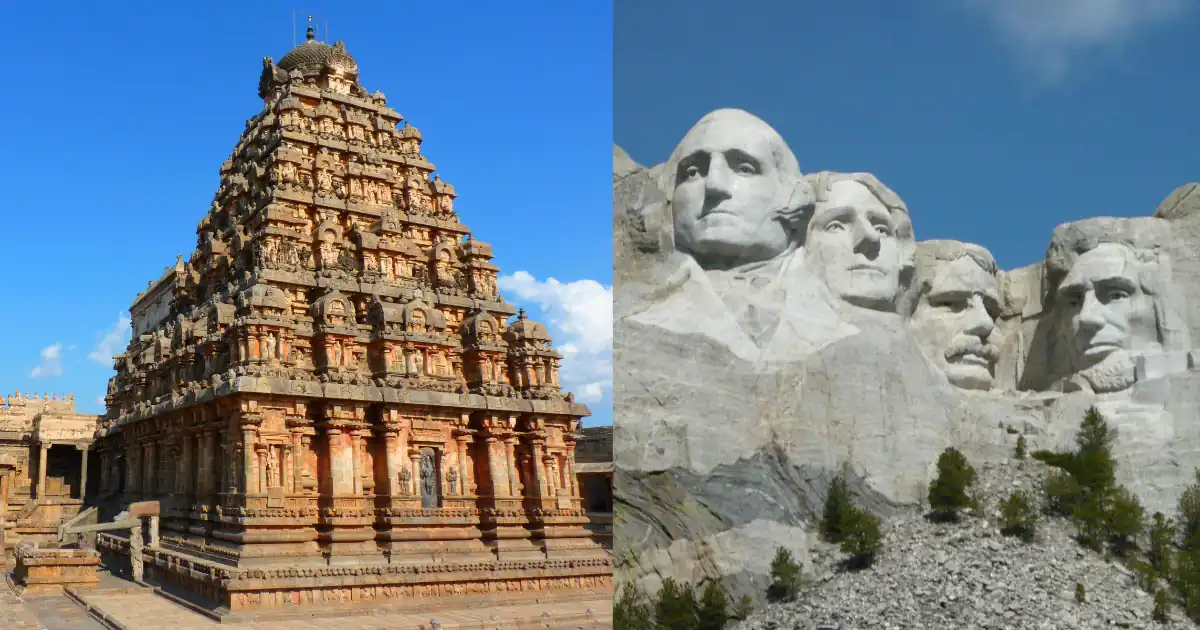
From sacred temples to civic monuments, granite has long been the stone of permanence, symbolism, and scale. In this post, we explore two iconic projects, one medieval and one modern. Both projects embody architectural grandeur through the enduring presence of granite.
Architectural Grandeur in Brihadeeswarar Temple
Era: Medieval South Indian (Chola Dynasty, 11th century)
Style: Dravidian temple architecture
The Brihadeeswarar Temple in Thanjavur stands as a towering example of architectural grandeur. Built entirely from transported granite, its 216-foot vimana and intricate carvings reflect both spiritual ambition and engineering mastery. What’s truly inspiring is that the Chola engineers sourced over 130,000 tons of granite from distant regions and shaped it into a temple. This temple withstood a millennium of monsoons, invasions, and cultural shifts, despite the absence of local quarries.
Transported Granite and the Chola Vision
The grandeur of Brihadeeswarar Temple begins not with its carvings, but with its logistics. In a region devoid of local granite, the Cholas envisioned a structure that would outlast dynasties, and moved mountains, quite literally, to make it happen.
Sourcing Stone Beyond Borders
Granite was transported from quarries over 50-60 km away, likely from the Pudukottai region. This decision was not only practical but also symbolic, as it asserted dominion over both material and territorial resources.
Engineering the Vimana
The 216-foot vimana, one of the tallest in Indian temple architecture, was constructed using interlocking granite blocks without the use of mortar. Its weight and balance remain a marvel of medieval engineering.
Carved Permanence and Editorial Legacy
Granite’s hardness didn’t deter the Cholas; instead, it challenged them. Every surface of the temple, from plinth to pinnacle, carries inscriptions, deities, and decorative flourishes that have endured for over a millennium.
Sculptural Precision in Stone
Despite granite’s density, artisans were able to achieve remarkable detail from the fierce guardians at the entrance to the delicate scrollwork on pillars. These carvings reflect both spiritual devotion and technical mastery.
Inscriptions as Editorial Anchors
Over 100 inscriptions in Tamil and Sanskrit document temple grants, rituals, and royal decrees. These aren’t just records, but they are editorial overlays in stone, timestamping the temple’s civic and spiritual role.
To explore how Indian stones blend art and architecture across eras, visit our feature on Indian Natural Stones: A Fusion of Art and Architecture.
Monumental Granite in Mount Rushmore
While the Brihadeeswarar Temple transported granite to elevate the sacred, Mount Rushmore carved directly into native stone to immortalise civic ideals. Both projects, separated by continents and centuries, converge in their pursuit of architectural grandeur.
Native Granite and Monumental Vision
Mount Rushmore rises from the billion-year-old Harney Peak granite of South Dakota’s Black Hills. Sculptor Gutzon Borglum chose this site for its fine-grained resilience, ideal for a monument meant to endure both time and scrutiny.
Carving a Civic Legacy
Between 1927 and 1941, over 400 workers removed 450,000 tons of granite to sculpt the 60-foot faces of four U.S. presidents. The project fused Beaux-Arts ideals with American realism, creating a civic landmark of unprecedented scale and significance.
Granite as a National Canvas
Unlike transported stone, the sculptors carved this granite in situ. Its permanence is symbolic of the ideals it represents. The mountain itself became the medium, reinforcing granite’s role in shaping national identity.
Editorial Echoes of Architectural Grandeur
Mount Rushmore’s grandeur lies not just in its scale, but in its editorial clarity. It tells a story of ambition, permanence, and the power of stone to carry meaning across generations.
Presidential Symbolism in Stone
Each face, Washington, Jefferson, Roosevelt, and Lincoln, was chosen to represent foundational ideals. Their placement in granite signals a desire for those ideals to be as enduring as the mountain itself.
A Presidential Reflection
“Mount Rushmore will stand as a testament to the power of human determination and creativity.”
Franklin D. Roosevelt
This quote, delivered during a 1936 dedication speech, captures the monument’s spirit and the role of granite in preserving it.
Granite’s Architectural Grandeur Across Civilisations
Across centuries and continents, granite has served as both medium and message. While the Brihadeeswarar Temple reflects spiritual permanence through transported stone, Mount Rushmore showcases civic symbolism carved directly into native granite. Together, they embody architectural grandeur, not merely in scale, but in editorial clarity and intent.
Moreover, these projects remind us that stonework is never just structural, but it is cultural, historical, and deeply expressive. To explore how granite continues to shape civic monuments, visit the Mount Rushmore National Park Service page.